

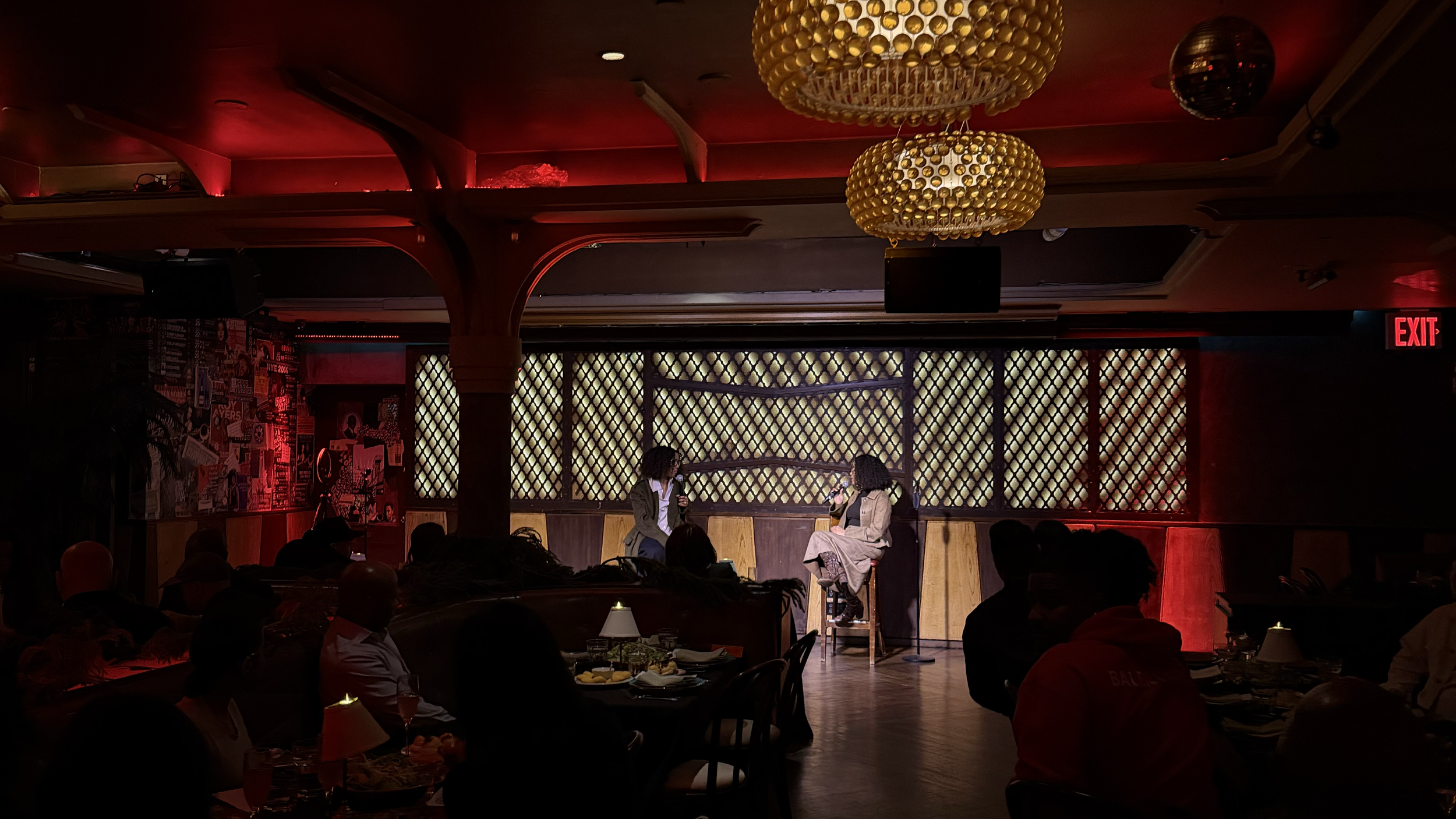
On a Wednesday night on the corner of Malcolm X Boulevard and W 126th Street in Harlem, New York, guests file down the carpeted stairs of the neighborhood’s beloved Red Rooster. Just ahead, an eight-foot original Kehinde Wiley portrait postures itself, deep cobalt blue and regal gold swirling around a Black man with his nose tipped to the sky, as if greeting every guest as they anticipate the night ahead.
With two stools awaiting on stage for the night’s special guests, Group Strategy Director Alicia Harris and WNBA veteran Sydney Colson, and walls plastered with posters from past events hosted in this very room, Translation’s Culture Consulate is set to enter a league of legendary nights in the space.
When Harris grasps the microphone and invites Colson onto the stage, the night snaps into focus. Together, they prepare to map the forces pushing women’s sports forward: fandom, culture, media, and the kind of brand to player partnerships that truly respect the people powering the game.
In a room built on culture, it feels natural that the conversation begins with the very thing culture runs on, people. For Colson, it’s the athletes that are the source of connection for women’s sports fans both new and old because fans often see themselves in the player’s ambition, personality, and interests outside of the game. “Whether I’m playing or not,” Colson says, “I still have another side to me that people can latch on to.”
That fan-to-player bond, she believes, is the heart of why women’s sports has grown so exponentially. Fandom is in no way passive, it’s deeply personal. This means of connection doesn’t just signal how new fans will continue to get involved and grow the sport, it’s a directive that Colson has for any brand that desires true partnership within that growth.
The game of basketball, Colson reminds the audience, stopped being confined to the court a long time ago. The game sprawls across cultural avenues now: a Vogue spread on tunnel walks, Flau’Jea Johnson appearing in major hip-hop records, the StudBudz duo Courtney Williams and Natisha Hiedeman emerging as popular Twitch streamers. These moments are entry points for waves of new fans that are evolving what it means to be a fan. Colson recalls the moment she knew something had fundamentally shifted: “It’s gotten to the point where my brother said, ‘Y’all are a big deal now because I got guys on our lunch break talking about the WNBA, like arguing in the lunchroom.” The audience lets out an amused laugh, but her point is clear: the WNBA had breached a boundary it had been knocking on for decades.
This expansion goes hand in hand with the non-traditional channels subverting the modern media landscape. The way that player and fan-led social channels are driving the growth of the game is shifting the directional flow of public attention. Colson, with 15 years of experience in the WNBA, says players used to have to wait for brands to come to them for collaborations. Now, by putting influence in the hands of players and fans who are leaning on authenticity and niche to find their own lane in the landscape, brands have a way of connecting with niche audiences earlier on.
Yet this increase in league visibility brings into view the values players have defended for years. Being a significantly Black and queer league, Colson believes WNBA players have always been drivers of cultural impact and social change. The “sudden” explosion of women’s sports is therefore not so sudden to her at all. It’s the result of the ceaseless devotion of players—and fans—who have been advocating for more respect. Colson, and other veteran players like her, can serve as ambassadors guiding brands on how to engage with the game because they’ve lived through its history.
“When you are coming to be involved with a league like ours, you have to know that the people you're getting involved with stand for something,” Colson says. “And so, to me, I would imagine that means that you stand for something [too] if you're coming to work with [us].” Veterans like Colson, who've spent years watching the league evolve, serve as crucial translators for brands still learning the language.
The most resonant collaborations with players, therefore, spring from moments of dialogue, where players aren’t just featured, but have a real voice in shaping the conversation with the brand. Partnership, in this era of women’s sports, launches from mutual respect, shared values, and a willingness to build alongside the people who have made the game what it is long before it was trending.
This is precisely the ethos that has galvanized years of work from Translation’s client Ally Financial. Through initiatives like the 50/50 Pledge—their commitment to reach equal spending in media across men’s and women’s sports within just five years—and signing on as a founding partner of Unrivaled in 2024, Ally has remained a consistent brand in the space. Translation has been proud to help Ally live out this promise, creating storytelling that advances the growth of women’s sports through the spirit of financial empowerment. When we launched “Big Buckets,” a spot featuring WNBA stars Paige Beuckers, Sydney Colson, and Breanna Stewart during the 2025 Draft, the work quickly became the brand’s highest performing post across their organic channels. The work was powerful because it connected Ally’s long-standing belief in financial empowerment in women’s sports directly to their product messaging. Women’s sports is too often framed as impact work—valuable, but contained. But what it really is, is a direct multiplier of brand investment, an opportunity that brands can’t ignore.
“We want this to grow. We want to grow with the right people…The companies that come and listen to the players, they are the ones that do the best,” Colson’s words hang in the room as Harris welcomes the final gift of the night on stage: a performance by UnitedMasters singer, songwriter, and violinist Sherie. As we snap and bob our heads, Sherie’s voice weaves itself into the fabric of the night right alongside Wiley’s portrait and the posters that greeted us.
Pictured above: Sydney Colson and Alicia Harris discuss how brands can create meaningful impact in women’s sports through true partnership rather than sponsorship. Photo by Ariana reyes.